For any of the selected charts you can view one of the astro sheets below. To determine the chart (or charts) to use, choose them from the dropdown lists at the top of the Astro Sheets window.
1 CHART - General
1) |
WHEEL: |
Single wheel |
2) |
GRID: |
Aspect grid |
3) |
WHEEL & GRID: |
Single wheel & aspect grid |
4) |
POINTS LIST: |
For each chart point - longitude, motion direction (D/Rx), travel, latitude, right ascension, declination, azimuth, altitude |
5) |
HOUSE CUSPS: |
Lists house cusp longitudes to second of arc plus a separate tabulation of nearest aspects from chart points to house cusps. Notably, this works with transformed house cusps of harmonic, duad and antiscia charts, rather than adopting the equal house cusps that are necessary for chart wheel display (as they keep the houses in a displayable order) |
6) |
SYZYGYS & ECLIPSES: |
Shows at birth the major lunar phases, and nearest prenatal and postnatal eclipses |
7) |
WHEEL + BASICS: |
A page of information => a single wheel, scores for elements/sign and house modalities/polarities => a list showing point glyph, longitude, motion direction (D/Rx), house; nearest aspects less than 1° orb sorted from smallest to largest orb
See NOTES below for information on how the score for elements, sign and house modes, and polarities are calculated |
8) |
BEGINNER / CLIENT: |
A page of information - general info on signs and aspects => a single wheel, scores for elements/sign and house modalities/polarities => a list showing chart point glyph, chart point, point sign, point house |
9) |
ASPECT PATTERNS |
Lists a range of standard aspect patterns found in the currently selected chart, showing which points are involved and a relative orb indicating the pattern tightness from 0.0 (tightest pattern orbs) to 1.0 (loosest pattern orbs). This is based on a root mean square ensemble calculation of all relative aspect orbs involved in the pattern. Clicking on an entry in the tabulation highlights that aspect pattern entry and applies a filter to the aspect ring of the selected chart's wheel, filtering it to show only the aspects involved in the selected pattern. The aspect patterms included are: •Stellium (any 3 points or more all conjunct one another) •T-Square •Grand Trine •Yod •Thor's Hammer •Grand Cross •Kite •Mystic Rectangle •Hard Rectangle •Focussed Yod •Rosetta •Hele •Double Yod Key •Square Key •Quintile Kite •Grand Quintile •Diamond •Stretched Pentagram •Star of David |
1 CHART - Predictive
10) |
PROG LUNAR |
Shows progressed lunar phases over the lifetime. The lunar phase entry that is highlighted by a grey band is the one that is current now. |
11) |
LIFETIME ARCS: |
"Life Time Astrology" is a book by A.T.Mann describing a “time scale” that can be aligned with a chart to date significant events in the native's life. Astrology has a series of twelve houses that seem like a sequence, and lifetime arcs maps the houses to sequential influences in the native's lifetime. But rather than starting at the ASC as the birth moment, everything starts at the cusp of the 9th house as the Conception point, when the parents made love and conception occurred. Thus from the 9th house cusp to the Ascendent is the Gestation Octave, time within the mother which is an intrauterine repetition of the entire evolutionary process, which Jung called “The Collective Unconscious.” The native takes on karmic lineages from the father and mother, added to the mother’s attitude, feelings and experiences while she carries the native, as karmic imprints or samskaras (in Buddhism). The Ascendant is birth as a process of delivery, and echoes how the native expresses themselves. Childhood is represented by the first four houses up to seven years old, and is the development of the personality (emotional body) within the home and family system. From the 5th house cusp back up to the 9th house cusp is the Maturity Octave, stretching to the end of life out in the world. There is also a Transcendent Octave, a higher level of gestation which influences the higher, more collective impulses that are often transpersonal, beyond the daily personal life. The Life Time Arcs show a list of dates from Conception to Old Age in a logarithmic time scale, showing a sequence of planetary sensitive points (aspect angles from each planet’s natal position) that show a succession of planetary patterns that describe the life in time. This sequence is similar to the structure of DNA and are sequenced in groups of three (like midpoints ortriplicities) that show what happens as aging and growth occur.
=> For each arc there is a date, the aspect to the sensitive point, the radix chart point making the aspect, the native's age on that date, and the longitude of the sensitive point • Using the gear icon |
12) |
SUN SIGN WHEEL: |
For use when doing Sun Sign columns etc. For the selected chart this sheet shows a single wheel, with the Ascendent at 0° of a the selected zodiac sign. • Using the gear icon |
13) |
SUN SIGN WHEELS: |
For use when doing Sun Sign columns etc. For the selected chart this sheet shows 12 wheels, each with the Ascendent at 0° of a different zodiac sign |
 (top right)
1 CHART - Traditional
14) |
ESSENTIAL DIGNITIES: |
For each chart point - ruler, exaltation, triplicity, term, face, detriment, fall, the overall score for the planets out to Saturn Also shows the planetary day and hour, and the hour of the day or night the chart time is |
15) |
HOUSE |
Has a tabulation listing house cusp numbers, longitudes, dispositors and almutens (using traditional rulerships). |
16) |
PLANETARY SECT: |
Comprises sect (distinction between day and night) information for the chart. Diurnal The first column ("Pt") is the planet, and the second column ("nature") is the intrinsic sect nature of the planet (diurnal or nocturnal). The last column ("Munakara") delineates that the planet is in a state of contention. Planet A is in Munakara (state of contention) when it is ruled (using traditional rulers) by Planet B, which has a different sect nature to itself, and Planet B is ruled by Planet C which also has a different sect nature to itself. E.g. the Sun (has a diurnal sect nature) is in Aries, and so is ruled by Mars (which has a nocturnal sect nature). Because Mars rules the Sun yet has a different sect nature to the Sun, potentially there may be discord between them. Whether that potential discord will become actual then depends on the sect condition of the planet ruling Mars. If the sect nature of Mar's ruler is the same as the sect nature of Mars (nocturnal) no further disharmony is involved and the potential discord is unlikely to become actual. But if Mar's ruler has a different sect nature (i.e diurnal) to Mars sect nature (nocturnal), that means further disharmony is involved and the original disharmony between the Sun and Mars will manifest, and the Sun is in Munakara - a state of contention.
"Munakara gives us an idea of the dangers of crossing boundaries – twice – and the trouble a planet can get into when it moves through enemy territory. Imagine the youngest child in a family of three siblings. If the middle child is getting picked on by the eldest because they are suffering their own torments, then retaliation goes back to the smallest child, who risks danger from both its elder siblings. Each of the planets reacts differently to being in munakara according to its own character and its significations are often areas of stress for the individual". Munkara information is from Joy Usher, and her source is Al-Biruni, Book of Instruction in Art of Astrology, Notation 497, p. 308 |
17) |
ALMUTENS |
Shows a list of 14 selected compound almutens with the highest scoring planets and their almuten dignity scores. Clicking on any almuten shows an interpretation popup. For astrologers working with classical methods, Astro Gold includes both Al-Qabīṣī’s simple Almuten Figuris calculation and Ibn Ezra’s Chart Almuten, two influential approaches that were widely used in medieval astrology. Abraham Ibn Ezra (c. 1089–1167) was a renowned Jewish astrologer, scholar, and philosopher whose astrological writings helped transmit Arabic astrological knowledge into medieval Europe through Latin translations. Astro Gold uses the Latin tradition of Ibn Ezra’s Chart Almuten method as preserved in these medieval sources. Al-Qabīṣī (Abū al-Ṣaqr al-Qabīṣī, c. 980), one of the most influential astrologers of the Arabic tradition, is best known for his clear and practical approach to astrology. Astro Gold implements his straightforward Almuten Figuris calculation method, making this important traditional technique easily accessible within the software. In traditional astrology, the Chart Almuten is the planet that holds the greatest overall authority or influence within a chart, determined through a system of accumulated essential dignities and planetary strengths. Astro Gold uses unweighted dignity scores and 5 degree cusp offsets. Special thanks to Rob Bailey of Old School Astrology for his valuable historical research and assistance in bringing these traditional methods to Astro Gold. |
18) |
DIGNITIES / HORARY: |
A page of information => planetary day and hour, a 30° modulus strip => a list showing point glyph, longitude, speed, travel, declination => a list showing point glyph, ruler, exaltation, triplicity, term, face, detriment, fall, score => a list showing a very few closest aspects with orb shown as time from exact |
19) |
DIGNITIES/ |
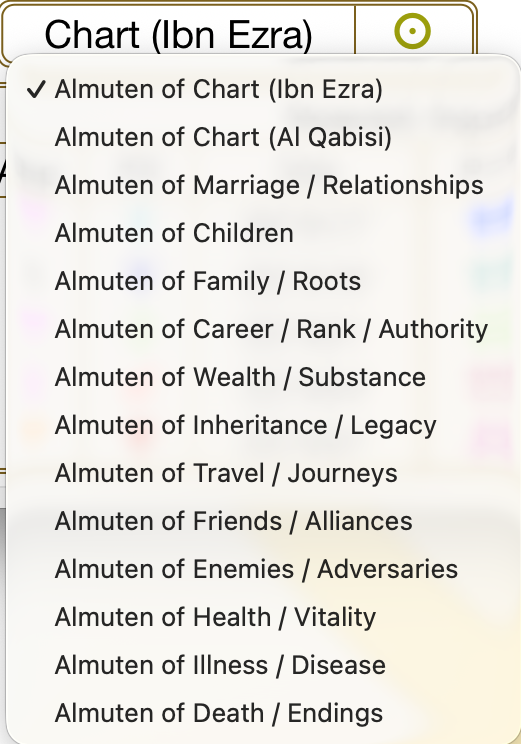
Shows the 16 closest Aspects, the Essential Dignities and the Planetary Sects (see sheet #12 above for info on planetary sects). Shows a specific Almuten. Initially set to show the highest scoring planet(s) for the Almuten Figuris.
Other almutens available can be viewed by right-clicking on the current almuten and selecting the one you want to see in the resulting list:
|



Time Lord activation in the Radix Chart
Planets become activated in a radix chart when they become "Time Lords". This means a planet becomes the highlighted planet in a chart via some technique's rules, and when it does then during a certain specified period of time it has an increased influence - in both the radix chart and also as transits to the chart.
These activations show when certain indications in the natal chart are most likely to manifest i.e. the planet ruling the activated sign will perform its best. The activations work by stepping through the chart, (traditional) planet by planet (and for Firdaria also the lunar Nodes), giving each planet (or node) “rulership” over a period of time in an individual’s life.
There are three such Time Lord based techniques available in Astro Gold - Firdaria, Profections and Zodiacal Releasings.
20) |
FIRDARIA: |
Firdaria show significant astrological periods from birth to age 100 Each planet has a period of greater years and a period of lesser years The individual’s life is broken up into time periods ruled by a planet or pair of planets The quality of life at that time is shown by the nature of the planets involved, along with their condition in the natal chart A Venus-Jupiter period would indicate great prosperity and joy, while a Mars-Saturn period would be one of hardship The only thing you have to determine is whether the chart is diurnal or nocturnal You then begin with either the Sun or Moon accordingly as the ruler of the first major period of life Each major period is divided into 7 sub-periods, ruled in order by the other planets, beginning with the ruler of the major period
=> The list shows each planetary period and within that its sub-periods, when that period or sub-period begins and the native's age at that time • In the gear icon |
21) |
PROFECTIONS: |
For the first year of life, by default the sign the Ascendant is in is the activated sign, and the ruler of that sign becomes the Time Lord for the first year. After that, on your birthday each year, the following sign (in zodiacal order) becomes activated, and so the ruler of it then becomes the Time Lord for that year Thus after 12 years all the signs in the chart have become activated, so in the 13th year the first sign becomes re-activated again, and so on
=> First nine 12 year periods in the native's life are listed, labeled with the native's age at the beginning of the period (the first period starting at the chart date). For each 12 year period listed, the 12 years within it are shown, labeled with the native's age at the beginning of each year. For each of those years the activated sign is shown, and it's ruling planet (which is the Time Lord for that year), plus the 12 months within it are also shown, labeled with the native's age at the beginning of each month, along with the activated sign and the Time Lord ruler of that sign
• The initial activated sign doesn't need to be sign the Ascendent is in. Using the gear icon Ascendent, Midheaven, Sun, Moon, Lot of Fortune
• Using the gear icon - Hellenistic (Wholesign); using Profections (Wholesign/year or Wholesign/month) directions - Medieval (Sign); using Profections (Sign/year or Sign/month) directions |
22) |
ZODIACAL RELEASINGS: |
Also divide a person’s life into periods of time using activated signs, but the periods are longer e.g. decades The number of years a sign is activated, is the same as the years of its ruler's planetary period (orbital period) Any sign can be the sign that is (first) activated at birth, but by default the sign the Lot of Spirit is in is activated first. Use the gear icon Traditionally using the sign of the Lot of Spirit is best for things like worldly direction and career, and the Lot of Fortune for bodily health
Once the years associated with a sign have transpired in the native's life, the next period starts using the next sign in zodiacal order to the previous one, and so on There are also sub-periods that are months as opposed to years long (level2), and sub-periods within those lasting weeks (level3) and within that sub-periods lasting days (level4) In each level the same principle applies, i.e. the sign's ruler's planetary period is the number of years, or number of months, or number of weeks etc
=> Four levels are shown (years/months/weeks/days) with a list of activated signs applicable to each level, plus for levels 1 and 2 the native's age when each sign is activated, and for levels 3 and 4 the day and time when each sign is activated |
Additionally under 1 Chart Traditional are Lunar Mansions...
23) |
LUNAR MANSIONS: |
Are like a special zodiac just for the the Moon, based on the Moon's position relative to various groups of stars. There are 28 lunar mansions, corresponding to the average of 28 days it takes the Moon to circle the zodiac, are 12° 51' in the zodiac, starting at 0 Aries.
=> For all Displayed Points the Mansion number is listed, along with its English, Picatrix and Arabic nameClicking on a row in the list pops up a brief interpretation for the relevant Mansion. • The gear icon |
1 CHART - Midpoints
24) |
MIDPOINTS LIST: |
For each chart point and midpoint - modality, sign, longitude, modulus used, house. The modulus used can be 22.5°, 30°, 45°, 60°, 90°, 120°, 180°, 360° The list can be sorted by - point, sign, modality, modality & sign, or by modulus (if using this to sort by you also need to specify the specific modulus to use as well). NOTE: Extra points (selected as Displayed Points) will not be included in these midpoint lists. |
25) |
MIDPOINT TREES: |
For each chart point - shows any midpoints (or other points) the chart point is directly aspecting by the modulus used, and the orb involved. The modulus used can be 22.5°, 30°, 45°, 60°, 90°, 120°, 180°, 360° The allowable orb can also be specified. The list is scrollable allowing trees of unlimited length NOTE: Extra points (selected as Displayed Points) will not be included in these midpoint trees. |
1 CHART - Minor Bodies
26) |
ASTEROIDS LIST: |
Shows a list of Asteroids => glyph, name, number, longitude, motion direction (D/Rx), travel, latitude, right ascension, declination. • Using the gear icon |
27) |
ASTEROID ASPECTS: |
Shows the nearest aspects in a chart involving and asteroid or extra body, sorted from smallest to largest orb. • Using the gear icon |
NOTES re the Minor Bodies
[A] The makeup of the minor bodies is:
•Standard asteroids (67) - originally shipped
•Martha Lang Westcott's asteroids (71) - additional asteroids that can be downloaded
•Zane Stein's Centaurs & Dwarves (42) - additional extra bodies that can be downloaded
•Egyptian Mythological Asteroids (22)
•Muse Asteroids (11)
•All Asteroids & Extra Bodies (171)
•By default (when the app is first installed) the available minor body ephemerides are limited to 1500BCE to 2100CE.
•That can be extended to 3000BCE to 3000CE from the Astro Sheets/Asteroid List configuration (gear) icon - see below (however not all minor bodies have orbits that can be calculated for this entire period).
>> How to Download additional minor bodies, plus also extend their calculation range
1)In the View menu click on Astro Sheets, or in the Toolbar click on the Sheets icon.
2)In the "Astro Sheets" window, in the left hand pane Tree menu, under the "1 Chart" heading, "Minor Bodies" sub heading, click on the Asteroids List sheet (see Tree menu if this sheet isn't visible).
3)In the top right of the "Asteroids List" sheet click on the Gear icon. The menu below will drop down...
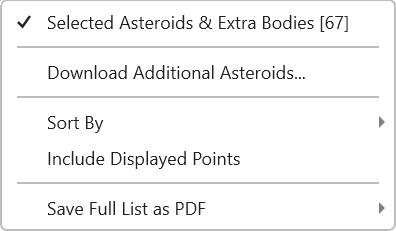
4)Click on Download Additional Asteroids. A dialog will pop-up at the top of the Astro Sheets window, as below.
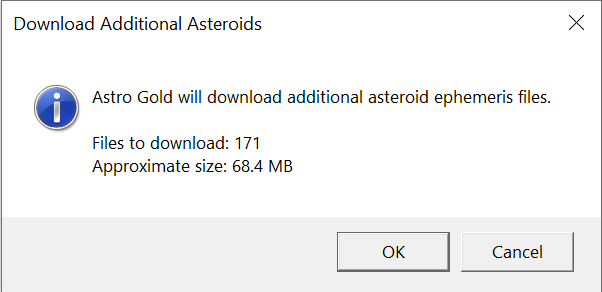
NOTE: The actual number available to download on your computer will depend on what you have, or haven't previously downloaded - it may not be the same as in the graphic above.
5)Click on the Download button to proceed.
6)Once the downloading has finished, you need to turn the display of these additional minor bodies on. In the top right of the "Asteroids List" Sheet click on the Gear icon again. This time the menu that drops down is different...
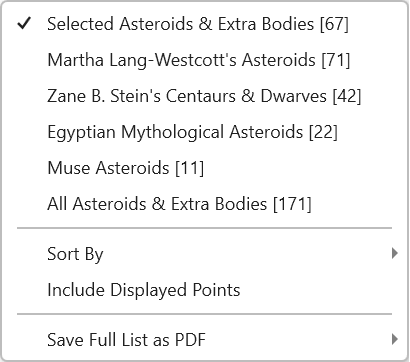
7)Select the set of minor bodies you want to be displayed in the Sheet by clicking on it. A tick will appear to the left of the option you selected.
NOTE: All of these additional minor planets will now also be available as Extra Points to put in charts along with all the other minor planets (see Displayed Points).
>> How to easily see asteroid conjunctions to the displayed points of the currently selected chart
1)In the View menu click on Astro Sheets, or in the Toolbar click on the Sheets icon.
2)In the "Astro Sheets" window, in the left hand pane Tree menu, under the "1 Chart" heading, "Minor Bodies" sub heading, click on the Asteroids List sheet (see Tree menu if this sheet isn't visible).
3)In the top right of the "Asteroids List" sheet click on the Gear icon. The menu below will drop down..
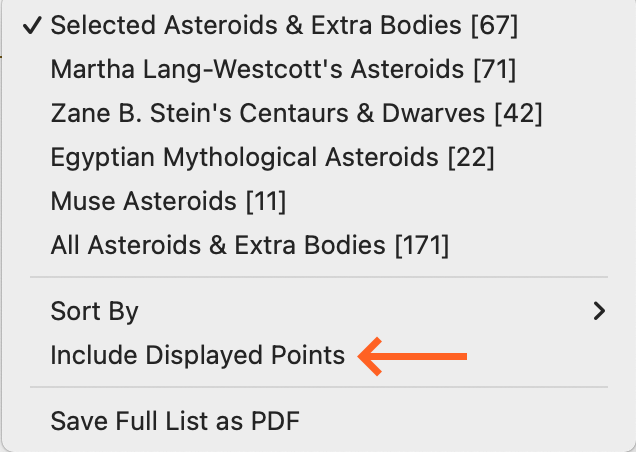
4)Click on Include Displayed Points. It will also become ticked, and the displayed points of the chart the Astro Sheets are for will be included as points in amongst the asteroids in the Asteroid List.
5)When the list is sorted by longitude and declination the asteroids that are conjunct these displayed points will be immediately before or after them in the list.
1 CHART - Lots/Parts
28) |
ARABIC LOTS LIST: |
A list of Arabic Parts => name, longitude, house • Using the gear icon |
29) |
ARABIC LOT ASPECTS: |
=> Aspects from either Al Biruni's Parts, Bonatti's Commodities, Hellenistic Lots or the Seven Hermetic lots to other points in the chart, sorted from smallest to largest orb. • Using the gear icon |
NOTES re the LOTS
Hellenistic Lots: Source is Dorian Gieseler Greenbaum.
Dorian has practised and taught astrology since 1992. In 2009, she received her Ph.D. from the Warburg Institute, London.
Her book, based on her PhD, The Daimon in Hellenistic Astrology: Origins and Influence, was published in 2016. She is also known for her book Temperament: Astrology’s Forgotten Key (2005).
Dorian lectures and teaches internationally (FAA, UAC, the British AA, University of Wales Trinity St David on the MA in Cultural Astronomy and Astrology). Her interests include astrological lots and how the daimon works in astrology while her current passion is to rename the Part of Spirit to its correct name, the Lot of Daimon.
The Seven Hermetic Lots: Source is Chris Brennan
Chris has a special interest in the history, philosophy, and practice of ancient astrology, and specilises in the Greco-Roman tradition of astrology known as Hellenistic Astrology.
He is the former President of the Association for Young Astrologers, and the former Research Director of the National Council of Geocosmic Research. He was also an associate editor and columnist for The Mountain Astrologer magazine, and served on the board of Kepler College.
Chris now hosts of a weekly podcast called The Astrology Podcast, and runs The Denver Astrology Group.
Tables of Sensitive Points in Helenistic astrology, and according to Al-Burini: can be found at: Arabian Parts - Astrodienst Astrowiki
1 CHART - Fixed Stars
30) |
STARS LIST: |
=> name, magnitude, longitude, latitude, right ascension, declination • Using the gear icon |
31) |
STAR ASPECTS: |
=> point glyph, aspect, star name, orb ...sorted from smallest to largest orb • Using the gear icon The Star Sets available are: ❖All Named Stars [507] ❖Benhenian (Hermes) Stars [15] ❖Brightest Stars ( Mag < 2.0) [48] ❖Ecliptic Stars (Lat < 10.0°) [132] ❖Hermes Stars [15) |
32) |
STAR PARANS: |
Parans are mundane angles between stars and chart points that are (in any combination of) rising, culminating, setting or located at the IC (the paran types). => point glyph, point paran (rises/culminates/sets), star, star paran, orb • Using the gear icon |
>> How to easily see star conjunctions to the displayed points of the currently selected chart
1)In the View menu click on Astro Sheets, or in the Toolbar click on the Sheets icon.
2)In the "Astro Sheets" window, in the left hand pane Tree menu, under the "1 Chart" heading, "Fixed Stars" sub heading, click on the Stars List sheet (see Tree menu if this sheet isn't visible).
3)In the top right of the "Stars List" sheet click on the Gear icon. The menu below will drop down..
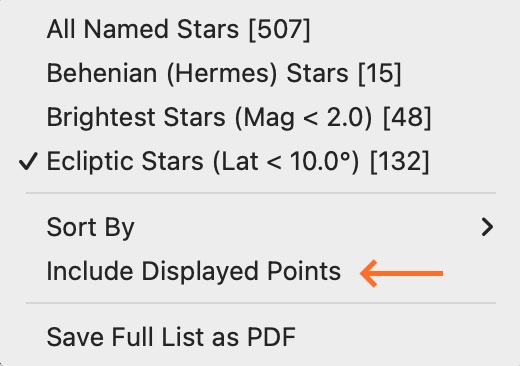
4)Click on Include Displayed Points. Now the displayed points of the chart the Astro Sheets are for will be included as points in amongst the stars in the Stars List.
5)When the list is sorted by longitude and declination the stars that are conjunct these displayed points will be immediately before or after them in the list.
1 CHART - Nodes & Apsides
33) |
NODES/APSIDES LIST: |
=> point glyph, point longitude, ascending (north) node longitude, descending (south) node longitude, geocentric distance, heliocentric distance, perihelion, aphelion All planets (except the Sun) have north and south nodes, just like the Moon does.
Apsides are the two key distances in the orbit of a planetary body about its primary body. In our solar system Perihelion is where a planet comes closest to the Sun, Aphelion is where a planet is furthest from the Sun.
Clicking on a row will pop-up Heliocentric orbital parameters for that point: ❖status (approaching or receding from the Sun) ❖distance info ❖next exact apside date |
34) |
NODES/APSIDES ASPECTS: (nearest aspects) |
=> point 1 glyph, aspect glyph, point 2 glyph, point 2 name, aspect orb • Using the gear icon The Node/Apside Types available are: ❖Ascending (north) Node ❖Descending (south) Node ❖Perihelion ❖Apihelion |
2 CHARTS
35) |
BIWHEEL: |
A BiWheel showing one chart in the inner wheel and a second chart in the outer wheel |
36) |
BIGRID: |
A BiGrid (square shape), with planets from one chart across the top, and planets from a second chart down the left Where they intersect any aspect between the planet from chart and the planet from the other chart is shown |
37) |
SYNASTRY: |
A page of information for two charts => 2 biwheels with the charts in different rings, a synastry grid => a list showing chart 1 point glyph, aspect glyph, chart 2 point glyph, orb - sorted from smallest to largest orb |
38) |
DUAL WHEELS: |
A page of information for two charts => each chart in its own single wheel, a synastry grid |
3 CHARTS
39) |
TRI-WHEEL: |
A TriWheel showing one chart in the inner wheel, a second chart in the middle wheel and a third in the outer wheel |
40) |
THREE WHEELS: |
Three charts, each in their own single wheel |
4 CHARTS
41) |
QUADRI-WHEEL: |
A QuadriWheel showing one chart in the inner wheel, a second chart in the inner middle wheel and a third in the outer middle wheel, and a chart in the outer wheel |
42) |
FOUR WHEELS: |
Four charts, each in their own single wheel |
Some of the available lists in Astro Sheets contain types of information not available in other places in Astro Gold, such as:
1.Scores for sign and house modes, elements and polarities. These scores are a measurement of the overall strength of the modality, element or polarity in the chart.
When calculating the scores for each of these items Astro Gold takes into account both the number of planets/points having that modality, element or polarity, plus the significance of each planet/point in the chart. Significance is related to how important in terms of everyday functioning that planet/point is on average, and the level of conscious access to that planet or point's energy/reality that is generally experienced.
Astro Gold initially assigns a score of 1 for each planet/point that belongs to a particular modality, element or polarity.
That initial basic score is then weighted according to it's significance, by multiplying it by the values below:
a.Multiplier 3 - Sun, Moon, Ascendant, MC
b.Multiplier 2 - Mercury, Venus, Mars
c.Multiplier 1 - Jupiter, Saturn, Uranus, Neptune, Pluto
d.Multiplier 0 - All other chart points
2.A more detailed list of chart points' data, midpoint trees, firdaria, profections and zodiacal releasings, and star parans/aspects etc
a.Firdaria uses the "Standard" system - with nodes at the end of the sequence by default. However you can change the system used to "Nodal Variant" in Preferences, Calcs.
b.Star Aspects and Star Parans are fixed star listings that utilize one of 5 pre-supplied Star sets.
c.Asteroid listing and aspects.